Documentation
A more complete account of the call
A synchronized timeline gives the paramedic time-aligned evidence to confirm instead of relying only on memory and manually reassembling events from separate systems.
Connect objective footage with monitor data and CAD so the patient care record can reflect what happened on the call, not only what can be reconstructed later. VeriMedic CaseSync turns those sources into one synchronized timeline, pre-fills NEMSIS fields in your existing ePCR, and gives QA reviewers source-linked evidence for protocol review.
Pushed to your ePCR — 2 fields to confirm
Shown with VeriMedic body cameras. QA and analytics also work without footage.
The short definition
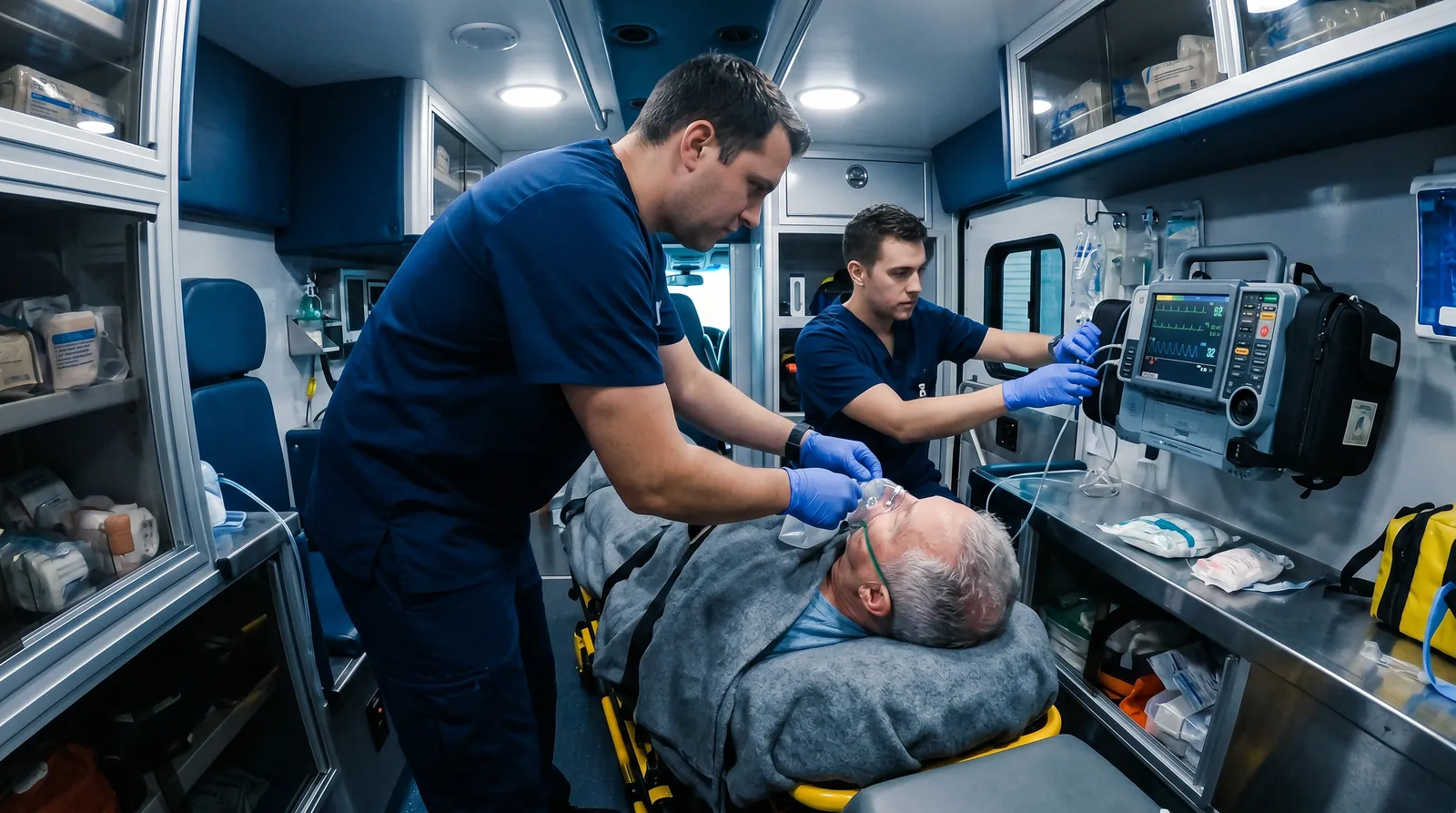
EMS body-camera documentation is a clinical workflow that aligns body-worn video with monitor and CAD data so paramedics can confirm supported NEMSIS fields in the existing ePCR and reviewers can assess the call against agency protocol.
VeriMedic makes CaseSync, an EMS-specific body-camera and software platform. CaseSync synchronizes body-camera video, cardiac monitor data, and CAD onto one timeline, drafts supported NEMSIS fields, and pushes them into the agency's existing ePCR for paramedic confirmation. CaseSync does not replace the ePCR. Authorized clinical reviewers use the same source-linked timeline for protocol-graded QA.
Use the linked guides for EMS body-camera benefits, risks, and privacy, an EMS body-camera policy checklist, NEMSIS data standards and fields, and EMS QA, QI, and record accuracy. Then compare how CaseSync feeds an existing ePCR and how protocol-graded QA differs from record review.
Why the record matters
National EMS education guidance describes the prehospital care report as serving continuity-of-care, legal, educational, administrative, research, and continuous quality-improvement functions. It also emphasizes accurate, synchronized times and documentation of assessment, care, patient changes, and scene observations. Read the EMS.gov guidance.
A conventional body-camera system preserves video. Body-camera documentation adds the clinical workflow around that evidence.
| Dimension | Footage archive | Clinical documentation workflow |
|---|---|---|
| Primary purpose | Record and retain video by incident | Use synchronized evidence to support the patient care record and QA |
| Evidence organization | A reviewer opens and scrubs an isolated video file | Video, monitor data, and CAD align on one clinical timeline |
| Relationship to the PCR | Footage sits apart from the record | Supported NEMSIS fields are pre-filled in the existing ePCR for confirmation |
| Routine QA | Video is often opened only when a call is already under review | Source-linked events can support protocol-based review and exception finding |
| Final decisions | People interpret the footage | Paramedics confirm documentation; authorized reviewers make QA judgments |
Video alone is not a patient care record. Its value grows when it is synchronized, structured, confirmed, and reviewed inside the agency's clinical workflow.
CaseSync sits between the encounter and the ePCR your agency already uses. It organizes the evidence; paramedics and authorized reviewers remain responsible for the record and the judgment.
The body camera records the scene while the monitor and CAD produce their own time-stamped data.
CaseSync aligns each source against one clock so clinical and operational events appear in sequence.
CaseSync drafts supported NEMSIS fields from the synchronized timeline.
Those fields flow into the agency's existing ePCR for the paramedic to review and confirm.
QA reviewers use the same source-linked timeline to evaluate the call against agency protocol.
Why it matters
The value is not video for its own sake. It is a better-organized record for documentation, protocol-based QA, and the questions that follow the call.
Documentation
A synchronized timeline gives the paramedic time-aligned evidence to confirm instead of relying only on memory and manually reassembling events from separate systems.
Quality assurance
Reviewers can move from a protocol criterion or surfaced exception to the relevant video, monitor, and CAD evidence instead of treating footage review as a separate investigation.
Continuity and review
More timely, accurate PCR content can support the receiving team and give the agency a better record when reviewing a complaint, unexpected outcome, or documentation question.
NEMSIS guidance connects complete and accurate PCRs with downstream care, meaningful QA/QI, protocol-compliance review, and legal proceedings. Read the PCR Data QuickGuide.
Footage can help preserve what was seen, said, and done, but it does not replace a clinical handoff or guarantee a legal outcome.
EMS QA on objective footage
Traditional record review begins with the completed PCR. CaseSync adds the synchronized source layer behind it, so a reviewer can move from a protocol question to the relevant moment in the timeline and see the associated monitor and CAD context.
The system supports the review; it does not decide whether care was clinically appropriate. Medical directors and authorized agency leaders retain that responsibility.
Objective footage is not a substitute for clinical judgment. It is a stronger record for applying it.See the CaseSync platform
Source-linked review path
Step 1
Start with the agency's defined standard—not a generic score.
Step 2
Open the relevant video, monitor, and CAD context on one timeline.
Step 3
An authorized reviewer decides what the evidence means for QA.
Identifiable EMS body-camera recordings contain protected health information. NEMSIS guidance explains that covered agencies must safeguard recordings and that HIPAA can permit uses for treatment and healthcare operations such as QA/QI, protocol development, and patient-safety evaluation. Read the EMS body-camera guide.
Agency policy should address
Requirements vary by jurisdiction. Agencies should involve qualified legal counsel when designing a body-camera program. This page is informational and not legal advice.
Straight answers about the record, the ePCR, QA, and agency responsibility.
See how CaseSync can connect body-camera video, monitor data, and CAD to the ePCR and QA workflow your agency already uses.